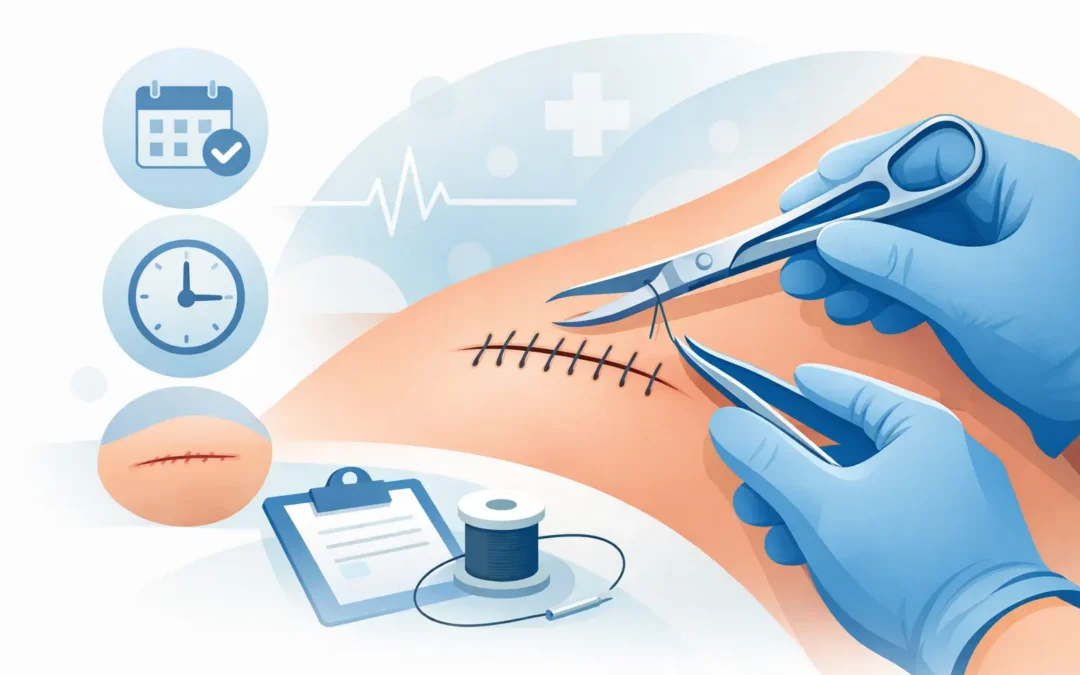
You glance at a healing cut and the same question comes up almost immediately: when do stitches need removal? The answer is not one-size-fits-all. Timing depends on where the stitches are placed, how deep the wound is, how much tension the skin is under, and how your body is healing.
That variability matters. Remove stitches too early and the wound can reopen, widen, or heal with a more noticeable scar. Leave them in too long and the skin may start to grow over the sutures, making removal more uncomfortable and sometimes increasing irritation or stitch marks. The goal is simple – remove them at the right moment, not the earliest possible moment.
When do stitches need removal by body area?
In most cases, non-absorbable stitches are removed based on location. Areas with excellent blood supply, such as the face, often heal faster and need removal sooner. Areas that move more, carry more tension, or heal more slowly usually need additional time.
A common timeframe looks like this:
- Face: about 5 to 7 days
- Scalp: about 7 to 10 days
- Chest, abdomen, arms, and back: about 7 to 14 days
- Hands and fingers: about 10 to 14 days
- Legs: about 10 to 14 days
- Palms and soles: about 14 to 21 days
- Over joints: often about 14 days or longer, depending on movement and wound tension
These are typical ranges, not guarantees. A small, clean cut on the forehead may be ready quickly, while a deeper wound over the knee may need more time because every step puts stress on the repair.
Why stitch removal timing is not the same for everyone
Two people can have stitches in the same area and still need different follow-up plans. That is because wound healing is influenced by far more than location.
Wound depth matters. Superficial cuts can close well within days, while deeper lacerations may have multiple layers of repair and require a more cautious timeline. If a wound edges together easily, removal is often more straightforward. If the skin was under tension at the time of closure, providers may leave stitches in longer or remove every other one first to avoid separation.
Your general health also plays a role. Diabetes, smoking, poor circulation, steroid use, immune suppression, and certain nutritional deficiencies can slow healing. Age can affect healing speed as well. Even something as practical as how much the area moves during daily life can change the plan.
This is one reason physician-directed follow-up matters. A proper stitch check is not just about taking sutures out. It is about confirming that the wound is sealed, clean, and healing in a way that supports both function and cosmetic outcome.
Absorbable vs non-absorbable stitches
Not all stitches need to be removed. Some are absorbable, which means the body gradually breaks them down. These are often used under the skin, inside the mouth, or in deeper tissue layers. Depending on the material, they may dissolve over days to weeks, and in some cases longer.
Non-absorbable stitches do need removal. These are the visible stitches many patients think of after a laceration repair. Nylon and polypropylene are common examples. Staples also require removal on a specific schedule.
If you are not sure which type you have, do not guess. Your discharge instructions should say whether removal is needed and when to return. If the instructions are unclear, it is worth confirming rather than waiting too long or trying to remove anything yourself.
Signs stitches may be ready for removal
A wound does not need to look perfect before stitches come out. It needs to look closed enough that the skin edges stay together without support. In many cases, the area will still be pink and mildly tender.
Good signs include edges that appear sealed, decreasing redness, less drainage, and improving soreness. Mild itching can also be part of normal healing. A clean, dry wound that is no longer pulling apart with ordinary movement often suggests healing is on track.
Still, visual improvement alone is not the final decision. Some wounds look fine at first glance but are not yet strong enough, especially in high-motion areas. That is why timing should be guided by a clinician, not by appearance alone.
Signs you should be evaluated sooner
Sometimes the real issue is not when stitches should come out, but whether the wound needs prompt attention before the planned removal date.
Seek medical evaluation if you notice increasing redness spreading outward, warmth, swelling, pus-like drainage, worsening pain, bad odor, fever, bleeding that does not stop, or wound edges pulling apart. Numbness, significant loss of movement, or skin discoloration around the site also deserve attention.
Not every red or tender wound is infected. Mild inflammation can be part of normal healing. But when symptoms are progressing instead of settling down, it is better to have the area examined promptly. A quick reassessment can prevent a minor wound issue from becoming a more complicated problem.
Can stitches stay in too long?
Yes. While many patients worry about removing stitches too early, leaving them in too long can also create problems. Sutures that remain past the ideal window may leave more visible track marks, become embedded, irritate the surrounding skin, or collect crusting that makes removal less comfortable.
This is especially relevant on the face, where timing affects cosmetic healing. In contrast, areas under more tension may justify a longer interval because preventing wound separation takes priority. Sometimes providers balance these goals by removing some stitches first and the rest a few days later, or by using adhesive strips for support after removal.
That is the nuance many people miss. There is no single “safe maximum” that applies to every wound. The right schedule reflects both healing strength and the importance of minimizing scar widening.
Should you ever remove stitches at home?
In general, no. It can be tempting, especially if the wound looks closed and you are busy. But home removal increases the risk of incomplete removal, wound reopening, bleeding, contamination, and avoidable scarring.
There is also the practical issue that not all stitches are equally easy to remove. Some are buried beneath dried blood or crusting. Some need the wound supported while tension is assessed. In a clinical setting, the site can be cleaned, evaluated for infection, and reinforced if needed.
For patients who value efficient, polished care, this is exactly the kind of follow-up that should be handled properly rather than rushed. At Dr. Farah VIP Urgent Care, wound checks and stitch removal are approached with the same careful attention as the original repair, because the finish matters just as much as the initial closure.
How to care for stitches until removal
Good aftercare helps you reach the right removal date without setbacks. Keep the wound clean and follow the instructions you were given about washing. Some wounds can get lightly wet after 24 to 48 hours, while others need longer protection depending on the repair.
Avoid soaking the area in baths, pools, hot tubs, or the ocean unless your clinician specifically says it is fine. Too much moisture can weaken the skin and increase infection risk. If the wound is in a high-motion area, try to limit strain, stretching, or exercise that pulls on it.
Apply ointment only if instructed. Covering the wound may be appropriate in some cases, especially if clothing rubs against it, but not every stitched wound needs a heavy dressing for long. The details depend on the location and type of repair.
When do stitches need removal after a complex repair?
For more complex lacerations, the timeline may be more individualized. A jagged wound, a deep cut involving multiple layers, a wound near the eyelid or lip, or a repair crossing a joint may not follow the standard chart exactly.
In these cases, the provider may want a recheck before the planned removal date, or may intentionally leave support in place longer. If there is swelling at the time of repair, the wound may also change over the next several days, which can affect management.
This is why discharge instructions should never be treated as a casual estimate. They are part of the treatment plan. If your paperwork says return in 7 days, that often means the wound should be assessed then, not that you should decide on your own whether to wait until day 10.
Healing is not a race. The best outcome comes from removing stitches when the wound is ready, not when the calendar feels convenient. If there is any uncertainty, a professional wound check offers clarity, reassurance, and the opportunity to protect both your recovery and your final result.